
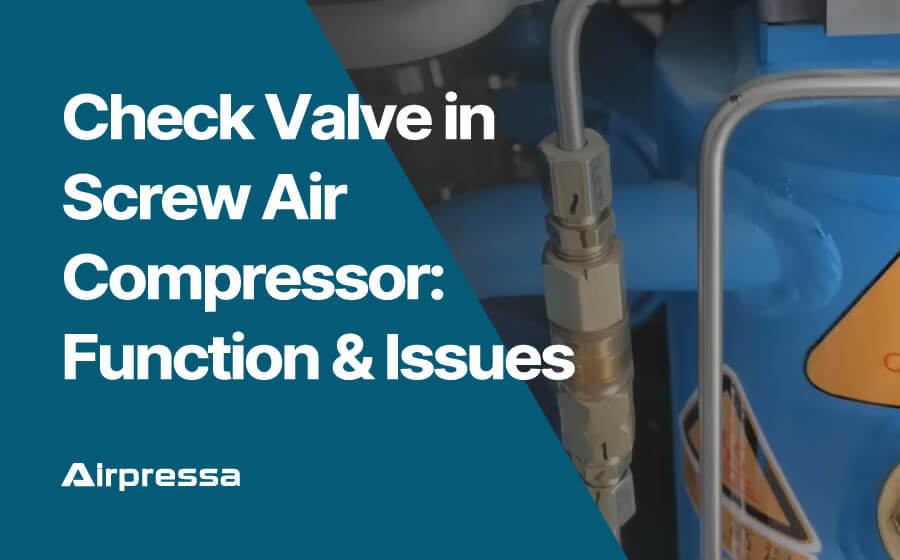
A stable compressed air system depends on controlled flow direction and reliable oil circulation.
This article explains how a check valve works inside a screw air compressor, why correct installation matters, what causes blockage, and how to identify early warning signs.
The goal is clear: reduce downtime, prevent oil carryover, and maintain consistent compressor performance.
You can click on any section that you interest to get there quickly.
The Function and Working Principle of a Check Valve
A check valve is a one-way mechanical device. It allows fluid or gas to move in one direction while preventing reverse flow.
In a screw air compressor, check valves are commonly used in:
- Oil return lines
- Discharge pipelines
- Minimum pressure valve assemblies
- Separator tank outlets
Their purpose is straightforward. They stop backflow when the compressor stops or when pressure differences change.
Basic Working Principle
The internal structure is simple. Most designs include:
- A valve body
- A movable disc or poppet
- A spring (in spring-loaded types)
- A sealing seat
When air or oil flows in the correct direction:
- Pressure pushes the disc away from the seat
- The valve opens
- Flow continues with minimal restriction
However, when flow reverses:
- Back pressure pushes the disc toward the seat
- The valve closes immediately
- Reverse flow is blocked
In Oil Return Systems
The check valve in the oil return line has a specific function. It ensures that:
- Separated oil flows back into the air end
- Compressed air does not flow backward into the separator
This is critical. Without it:
- Oil circulation becomes unstable
- Oil consumption increases
- Separator efficiency drops
How to Correctly Install the Check Valve on a Screw Compressor?
Correct installation directly affects performance and service life. Even a high-quality check valve can fail if installed improperly.
Follow Flow Direction
Every check valve has a flow direction mark, usually an arrow.
- Always align the arrow with the actual flow direction
- Reverse installation will block flow completely
This is one of the most common field errors.
Choose Proper Orientation
Some check valves are sensitive to installation position.
- Horizontal installation is standard
- Vertical installation may require upward flow direction
Incorrect orientation can cause:
- Incomplete opening
- Disc misalignment
- Increased wear
Ensure Clean Piping
Before installation:
- Clean the pipeline thoroughly
- Remove welding slag, dust, and debris
Contaminants introduced during installation often become the root cause of early blockage.
Provide Adequate Space
Avoid installing the check valve too close to:
- Elbows
- Reducers
- Other valves
Turbulent flow in these areas can:
- Affect valve stability
- Increase internal wear
Straight pipe sections before and after the valve improve performance.
Avoid Excessive Tightening Stress
Improper tightening can deform the valve body.
- Use proper torque values
- Ensure flange alignment
Mechanical distortion may lead to:
- Leakage
- Restricted internal movement
What Causes Check Valve Blockage?
A check valve in a screw air compressor is a simple component, yet it operates under continuous flow, pressure fluctuation, and contaminant exposure.
Blockage does not occur randomly. It develops progressively due to mechanical, chemical, and operational factors acting together.
1. Oil Contamination and Viscosity Changes
In oil-lubricated screw compressors, compressed air always carries a small amount of oil mist. Under normal conditions, this is controlled by the oil separation system. However:
- Poor oil separation efficiency
- Degraded oil quality
- Excessive oil carryover
lead to oil accumulation inside the check valve.
As temperature fluctuates, oil can:
- Thicken at lower temperatures
- Oxidize and form sticky residues (varnish) at high temperatures
These residues adhere to the valve disc, spring, and internal surfaces. Over time, this restricts movement or fully blocks the flow path.
If the above situation occurs, you may need to check whether the compressor’s oil-water separation element is clogged or malfunctioning.
Why Is The Air Compressor Oil Water Separator Clogged?
The air compressor oil water separator plays an important role in the compression process of air. It ensures that oil, water and other harmful substances do not end up in the compressed air system and pipe.
When the oil water separator get clogged, you could be in big trouble.
2. Carbon and Varnish Deposits
High discharge temperatures accelerate oil oxidation. This produces:
- Carbon deposits
- Varnish-like films
These substances are hard and adhesive. They tend to:
- Build up around the valve seat
- Restrict sealing surfaces
- Reduce valve responsiveness
This is more common in compressors operating under:
- High ambient temperatures
- Poor cooling conditions
- Extended service intervals
3. Particulate Contamination
Airborne particles entering the compressor system are another major cause. These include:
- Dust
- Rust particles from pipelines
- Wear debris from internal components
If filtration is insufficient or damaged:
- Particles accumulate inside the check valve
- They can lodge between the valve disc and seat
- This causes partial blockage or prevents proper closing
In severe cases, solid particles can completely jam the valve.
4. Moisture and Condensate Accumulation
Moisture is unavoidable in compressed air systems. Without proper drying:
- Water condenses inside pipelines and valves
- It mixes with oil and particles to form sludge
This sludge has a high tendency to:
- Settle in low-flow areas such as check valves
- Harden over time
Additionally, moisture promotes:
- Corrosion of internal metal surfaces
- Formation of rust, which further contributes to blockage
5. Corrosion and Material Degradation
Internal corrosion is often overlooked but critical. Causes include:
- Presence of water and oxygen
- Acidic byproducts from oil degradation
Corrosion leads to:
- Rough internal surfaces
- Flaking metal particles
- Reduced clearance inside the valve
This not only blocks flow but also damages sealing integrity.
6. Improper Installation or Orientation
Check valves are directional devices. Installation errors can create abnormal flow patterns:
- Reverse installation
- Incorrect orientation (vertical vs horizontal mismatch)
These issues may cause:
- Uneven force on the valve disc
- Increased likelihood of debris accumulation
- Reduced self-cleaning effect of airflow
7. Infrequent Operation or Low Load Conditions
In systems with intermittent use or low load:
- Air velocity is insufficient to keep the valve clean
- Contaminants settle instead of being carried away
This leads to gradual buildup, especially in:
- Backup compressors
- Systems with oversized capacity
8. Spring Fatigue or Mechanical Failure
Many check valves rely on springs for closing force. Over time:
- Springs weaken or deform
- Valve movement becomes sluggish
A slow or partially open valve allows contaminants to:
- Enter and remain inside
- Accumulate more easily
Mechanical wear can also produce internal debris, worsening blockage.
9. Poor Maintenance Practices
Neglecting routine service accelerates all the above mechanisms:
- Delayed oil changes
- Clogged air/oil filters
- Lack of condensate drainage
- No periodic valve inspection
Without maintenance, small deposits evolve into complete obstruction.
7 Causes of Compressor Lubricating Oil Consume Excessive
Many users of oil lubricated screw air compressors experience this scenario: not long after maintaining the machine, they find that the lubricating oil is consumed abnormally fast, accompanied by oil spills.
What Symptoms Indicate That the Check Valve Is Blocked?
A blocked check valve does not fail silently. It affects system behavior in several observable ways.
Increased Oil Carryover
When the oil return check valve is blocked:
- Oil cannot return efficiently to the air end
- Oil accumulates in the separator
As a result:
- Oil carryover into the compressed air increases
- Downstream equipment becomes contaminated
Abnormal Pressure Fluctuations
A blocked valve restricts flow.
This leads to:
- Pressure instability in the system
- Slow pressure build-up
- Unexpected pressure drops
Reverse Flow after Shutdown
If the valve cannot close properly:
- Compressed air flows backward
- Pressure equalizes between components
This may cause:
- Reverse rotation of the air end
- Mechanical stress on components
High Temperature in the Separator Tank
Poor oil circulation affects cooling.
- Oil remains trapped
- Heat dissipation decreases
Consequently:
- Separator temperature rises
- System efficiency declines
Unusual Noise or Vibration
A partially blocked valve may:
- Open and close irregularly
- Cause flow turbulence
This results in:
- Pulsating noise
- Vibration in pipelines
Increased Energy Consumption
Flow restriction forces the compressor to work harder.
- Higher load on the motor
- Longer running time
This directly increases operating costs.
Conclusion
The check valve is small, yet essential. It maintains flow direction, protects system stability, and supports efficient oil circulation.
However, contamination, oil degradation, moisture, and poor maintenance can lead to blockage. Once blocked, system performance declines rapidly.
Therefore, consistent maintenance is necessary. Clean filtration, proper oil management, and regular inspection can significantly extend service life and prevent costly failures.
Explore Screw Air Compressor Valve Types: The Ultimate Guide
There are many types of air compressor valves, each with their own unique and indispensable functions. They Together form the air compressor valve system, allowing it to operate safely and stably.
This article highlights the 11 main air compressor valve types. How do they work?